
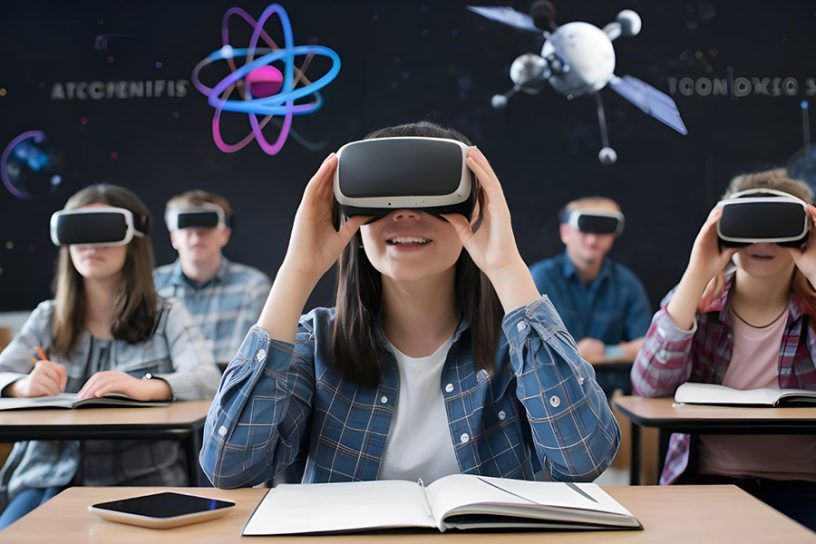

Virtual Reality (VR) and Augmented Reality (AR) can transform education through immersive learning, but thoughtful implementation and inclusive design are crucial for success.
Authors
Rohit Yadav, IILM University, Greater Noida, India
Xuan-Hoa Nghiem, Vietnam National University, Hanoi, Vietnam
Mohit Yadav, Professor, Jindal Global Business School, O.P. Jindal Global University, Sonipat, Haryana, India
Narayanage Jayantha Dewasiri, Qasim Ibrahim School of Business, Villa College, Maldives
Summary
This chapter explores the transformative role of Virtual Reality (VR) and Augmented Reality (AR) in education, focusing on their applications, benefits, and the challenges they present. VR and AR offer immersive, interactive learning experiences that enhance student engagement, foster collaboration, and enable personalized learning. The chapter discusses the technological foundations of VR and AR, their practical applications in various educational fields, and their potential to revolutionize the way we teach and learn. It also highlights the ethical and social implications, including privacy concerns, accessibility issues, and the psychological impact on students. Looking ahead, the chapter examines emerging trends, such as AI integration and mixed- reality experiences, which will further expand the possibilities for these technologies. Ultimately, the chapter emphasizes the need for thoughtful implementation and inclusive design to ensure that VR and AR can be leveraged to benefit all learners.
Published in: AI Smart-Enabled Architecture and Infrastructure for Higher Education
To read the full chapter, please click here.
