
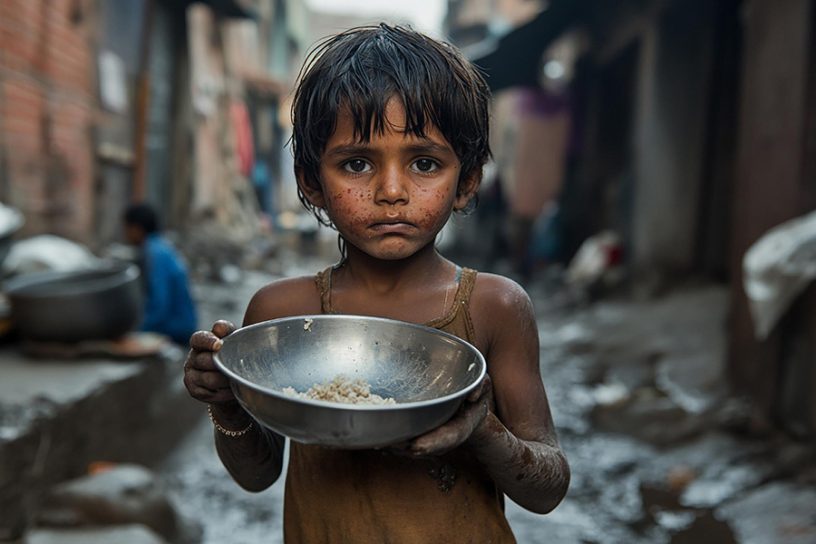

Hunger in India remains politically constructed, demanding justice-oriented, intersectional approaches that address persistent structural inequalities and silenced exclusions.
Authors
Avantika Singh, Department of Political Science, University of Delhi, New Delhi, India
Pankaj Kumar Jha, Department of Political Science, Motilal Nehru College, University of Delhi, South Delhi, India
Vaishali Sharma, Jindal School of Government and Public Policy, O.P. Jindal Global University, Sonipat, Haryana, India
Sachin Kumar Das, Department of Political Science, University of Delhi, New Delhi, India
Summary
This article develops a novel analytical framework by combining discursive periodization with an examination of persistent exclusions in the governance of hunger. Moving beyond the conventional “poverty/production” paradigm, it traces how Indian regimes since independence have framed hunger across five phases: famine and scarcity, entitlement, productivist modernization, liberalization, and rights-based digital governance. Employing the Discourse Historical Analysis (DHA), the study reviews policy documents, media, and academic sources to show how each phase redefined hunger while reproducing silences around inequality and structural injustice.The paper concludes by foregrounding hunger as a political construct and advocating justice-oriented, intersectional approaches to food security.
Published in: Journal of Hunger and Environmental Nutrition
To read the full article, please click here.
